
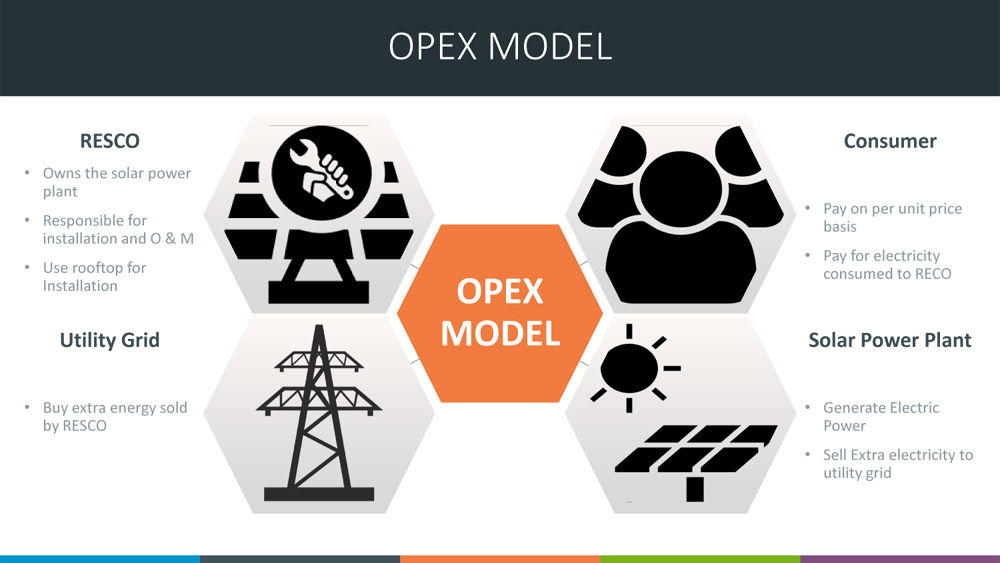
The Solar OPEX (Operating Expense) model is a financial arrangement that allows businesses or consumers to benefit from solar energy without the need for upfront capital investment in the solar power system. In this model, the ownership and operation of the solar installation are typically maintained by a third-party solar service provider or an energy company. The consumer or business pays a regular fee or tariff for the solar power generated, rather than owning the solar infrastructure outright. Here are the key features of the Solar OPEX model:
Third-Party Ownership: In the Solar OPEX model, a third-party entity (often a solar developer, energy services company, or independent power producer) owns, installs, and operates the solar power system. No Upfront Investment: The consumer or business is not required to make an upfront capital investment in purchasing the solar equipment. This reduces the financial barrier to adopting solar power. Power Purchase Agreement (PPA): The solar service provider and the consumer typically enter into a Power Purchase Agreement (PPA), outlining the terms and conditions of the arrangement. The PPA specifies the agreed-upon rate for purchasing the solar electricity generated by the system. Fixed Tariff or Rate: The consumer pays a fixed tariff or rate for the solar electricity over the term of the agreement. This rate is often lower than the prevailing grid electricity rates, providing immediate cost savings. Operation and Maintenance (O&M): The third-party provider is responsible for the operation and maintenance of the solar power system. This includes monitoring system performance, conducting regular maintenance, and ensuring optimal efficiency. Performance Guarantees: Solar OPEX agreements may include performance guarantees, ensuring that the solar system meets specified energy production targets. If the system falls short of these targets, the service provider may be required to compensate the consumer accordingly. Ownership Transfer Options: Some Solar OPEX agreements include options for the consumer to purchase the solar power system after a certain period or at the end of the contract term. This allows for potential ownership transfer and continued cost savings. Benefits of the Solar OPEX Model: Cost Savings Without Capital Investment: Consumers can benefit from solar energy cost savings without the need for a significant upfront investment in the solar power system. Immediate Cost Predictability: The fixed tariff or rate in the PPA provides immediate cost predictability, allowing consumers to plan their energy expenses more effectively. Outsourced Operation and Maintenance: The responsibility for system operation and maintenance is transferred to the third-party provider, reducing the burden on the consumer. Risk Mitigation: The third-party provider often assumes the risks associated with system performance, ensuring that the consumer receives the agreed-upon level of solar electricity. Alignment of Interests: The Solar OPEX model aligns the interests of the solar service provider and the consumer, as both parties benefit from the efficient and reliable operation of the solar power system.The Solar OPEX model has gained popularity, especially in commercial and industrial settings, as it allows businesses to access the benefits of solar power without the need for significant upfront capital and operational expertise. It provides a flexible and financially attractive option for organizations looking to adopt clean and sustainable energy solutions.